Profile view of a bearded man wearing a dark green baseball cap and a dark gray T-shirt against a plain light background.

Signs your furnace is undersized for a West Virginia home

New system or replacementFurnace or heatingWest Virginia
Step 1 of 2

What ZIP code is the job in?

What are the signs my furnace is too small for my house?

Most West Virginia homes heat with electric furnaces, and if yours is struggling to keep up on the coldest days, you're probably wondering if it was ever the right size for your house. Maybe you added a room, finished the basement, or the furnace came with the house and nobody checked the math. Either way, you want to know what undersized actually looks like before you spend a winter cold.

It runs constantly and still can't hold your set temperature

A furnace sized right for your house cycles on, heats the air, and shuts off. One that's too small runs almost nonstop in cold weather and the house still feels a few degrees under where you set it, especially in rooms farthest from the furnace. You may also notice cold spots that never warm up, or the thermostat reading 68 while it feels closer to 63 in the bedrooms. On the coldest nights of a West Virginia winter, an undersized furnace falls further behind, because it was never built to cover the heat loss your house has on those nights. If this matches what you're seeing, the fix isn't a thermostat setting. It's a furnace sized to the house.

A gas furnace with two gray access panels stands against a plain wall in a basement, connected to sheet-metal ductwork, white PVC vent pipes, and a yellow gas line.

Why it runs without stopping

An electric furnace sized right for your house cycles off once the thermostat is satisfied. One that's too small loses that race on cold mornings and just keeps running, pushing warm air that never quite catches up. Check the vents during a cold snap. If the blower hasn't shut off in an hour or more, the unit is working past what it was built to do, not warming your home efficiently.

A gray high-efficiency furnace in a basement corner with white PVC vent pipes, copper and black gas piping, and sheet-metal ductwork beside a plain white wall and wooden stair framing.

What the rooms farthest away tell you

Heat has to travel through the ductwork to reach the rooms at the far end of the house. A furnace with enough capacity pushes it there. One that's undersized loses the battle before the air arrives, so those rooms stay noticeably cooler than the one with the thermostat. If you've shut doors or added space heaters just to even things out, that's the furnace telling you it can't cover the square footage it was asked to.

Why does one room never warm up like the rest

Walk through your house on a cold morning and you'll likely find the room farthest from the furnace is the one with a coat on standby. An undersized furnace sends out heat, but there isn't enough of it to reach the far bedroom or the room over the garage once it travels through the ducts. You might also notice the thermostat reads 70 while that room sits closer to 60. Set your thermostat up a few degrees and the rest of the house overheats just to get that one room tolerable, and your electric bill climbs for it. Left alone through enough winters, pipes in the coldest rooms run a higher risk of freezing.

A dimly lit interior with wood plank flooring where a small portable heater with a glowing orange element sits near an open doorway, with a stove at left, kitchen cabinets and a potted plant at right, and a wooden table and chair in the foreground.

You're up before the rest of the house, and the kitchen is the only room worth being in. The space heater by the table is doing the work the furnace won't, its coil glowing orange, cord running back toward the outlet by the counter. The basement door stands open behind it, the stairs dark, because someone went down twenty minutes ago to look at the furnace again and came back up without an answer. Outside it's still that gray kind of cold West Virginia gets in February. You wrap both hands around your coffee and wait for the kitchen to feel like enough, because the rest of the house already feels like somewhere else.

A pro who works on furnaces

Send the form and the search for an installer is over.

Sending the form costs nothing.

A furnace that's the right size for your house costs more to run on the coldest day of the year than any other day. It still costs less over a full winter than one too small, because it isn't running nonstop trying to catch up.

An undersized furnace looks cheaper on the bill some months, because it can't push out enough heat to run up the cost. What it's really doing is leaving your house colder than you set it to be.

A gray-haired bearded man in a dark coat and scarf dusted with snow stands smiling in a dimly lit entryway with a white front door, a side table with a lit lamp, an oval mirror, and a patterned rug.
An older bearded man in a dark snow-dusted coat and gray scarf stands just inside a dimly lit home entry, with a framed picture, lit table lamp, and an adjoining room with a fireplace behind him, and snow visible through the open door.
A gray-haired, bearded man in a dark snow-dusted coat stands smiling in a dimly lit entry hall with a staircase, a lit table lamp, a framed picture, and a living room visible through a doorway.
An older man with gray hair and a beard, wearing a dark jacket dusted with snow, stands smiling in a dimly lit hallway with lamps and a living room visible behind him.

The furnace that was never enough

Some houses get a furnace that was undersized from the day it went in. Whoever installed it guessed low, or matched the old unit without checking if the old one ever kept up either. You've lived with it long enough to think the struggle is normal. It isn't. A furnace built for your house holds its temperature through a cold snap. One that never fit shows the same signs on day one that it shows years later, because the mismatch was always there.


The furnace that used to be enough

Other times the furnace was sized right when it went in, and something since has changed what the house asks of it. A room got finished out. Windows got swapped or added. An addition went up out back and tied into the same ductwork. The furnace is still the one that was sized for the house as it was, not as it is now, and on the coldest days it's working against square footage nobody accounted for.

A woman wrapped in a thick beige fleece blanket sits on a sofa with an open book on her lap, beside a lit table lamp, with a frost-covered window behind her.
A smiling older woman with gray hair in a cream knit sweater stands in a dimly lit kitchen beside a window showing snow outside, with a round loaf of bread on the counter in the foreground.

What a bigger furnace actually buys you

A furnace sized for your house runs long enough to push warm air into every room, then shuts off. You get even heat and quiet stretches where nothing is running. The right size also costs less to install than most people guess, since the unit itself scales with output, not with how fancy it is. You stop layering fixes on top of a system that was wrong from the start. No space heater in the kitchen, no closing off the back bedroom in January. It's a straightforward trade, more capacity for less daily strain on the equipment and on you.

What happens if you leave it as is

The furnace you have keeps running the way it's been running. It cycles long, falls behind on the coldest mornings, and leans harder on whatever room heater or extra layer you've already worked into the routine. Nothing about that gets better on its own, and West Virginia winters don't ease up to meet a furnace halfway. The parts inside it, the blower especially, wear faster carrying a load they were never sized for. Replacing it now means choosing the size on your terms. Waiting usually means replacing it later anyway, on a day when it's finally quit and you have no time to weigh the options.

Winter nights average 25°F statewide

A 25°F night is normal here, not a cold snap. Your furnace has to hold that line for hours at a stretch, not just push past one bad morning. If it can't keep the house warm on an ordinary January night, it was never sized for what West Virginia winters actually ask of it.

NOAA nClimDiv 1991-2020 county normals weighted by homes

A furnace that runs nonstop, a room that never warms, a space heater doing a job the furnace was built for: these all point to one thing, a furnace that was too small for your house from the start. No amount of adjusting the thermostat fixes that. The only real answer is a furnace sized for what your house needs on a cold West Virginia night, not the one that happened to fit the budget or match the old unit when it went in. You don't have to figure out what size that is on your own. Once you send the form, you're done hunting for someone to take this on. A contractor who installs furnaces for houses like yours will look at what you've got and reach out to you directly. You can stop layering up in your own kitchen and stop running a space heater that was never meant to carry the load. That part of this is no longer on you.

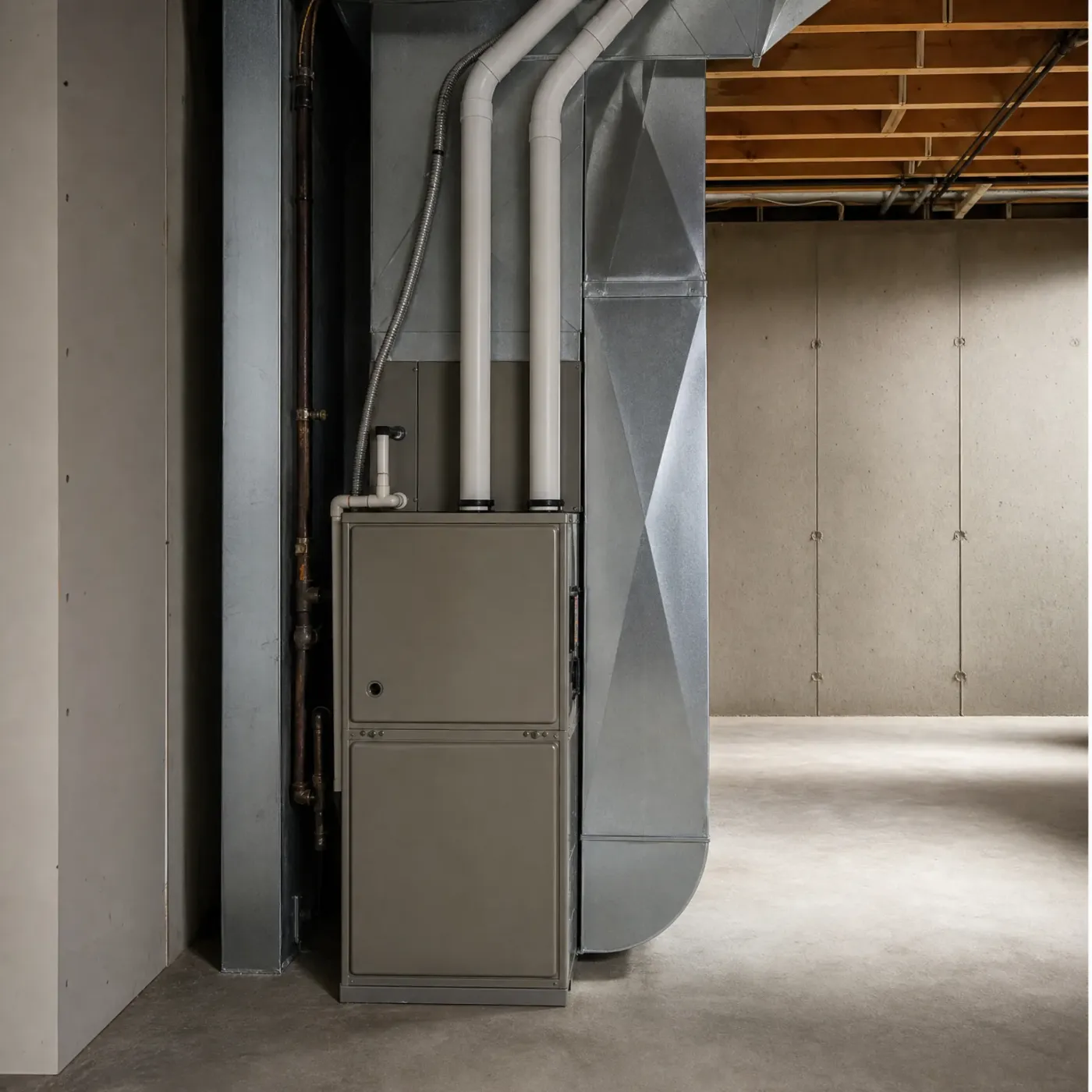
A gray high-efficiency furnace in an unfinished basement, connected to sheet-metal ductwork and two white PVC vent pipes, with copper piping and exposed wood floor joists nearby.

Get your furnace to the right pro

Get matched

Send the form and stop researching installers for the new furnace.

You're not committing to anything by asking.