


What to do when the AC goes out in West Virginia

RepairCentral ACWest Virginia
Step 1 of 2

What ZIP code is the job in?

What do I do when my AC stops working in West Virginia?

When your AC quits on a sticky West Virginia afternoon, the house heats up fast and everyone in it notices. You want to know what's worth trying yourself before the humidity makes it miserable, and when it's time to stop messing with it and get someone out to look at it.

Check the thermostat and breaker first, then call for repair

Start with the thermostat. Make sure it's set to cool and set a few degrees below room temperature. Then check your breaker box. Central air pulls enough power that a tripped breaker is one of the more common reasons a system goes quiet, and resetting it is safe to try on your own. If the breaker holds and the unit still won't run, or it runs but isn't cooling, stop there. A system that blows warm air in West Virginia humidity can mean a refrigerant leak or a failing compressor, and running it in that state can cause more damage. That's a job for a licensed technician, not something to keep flipping switches on.

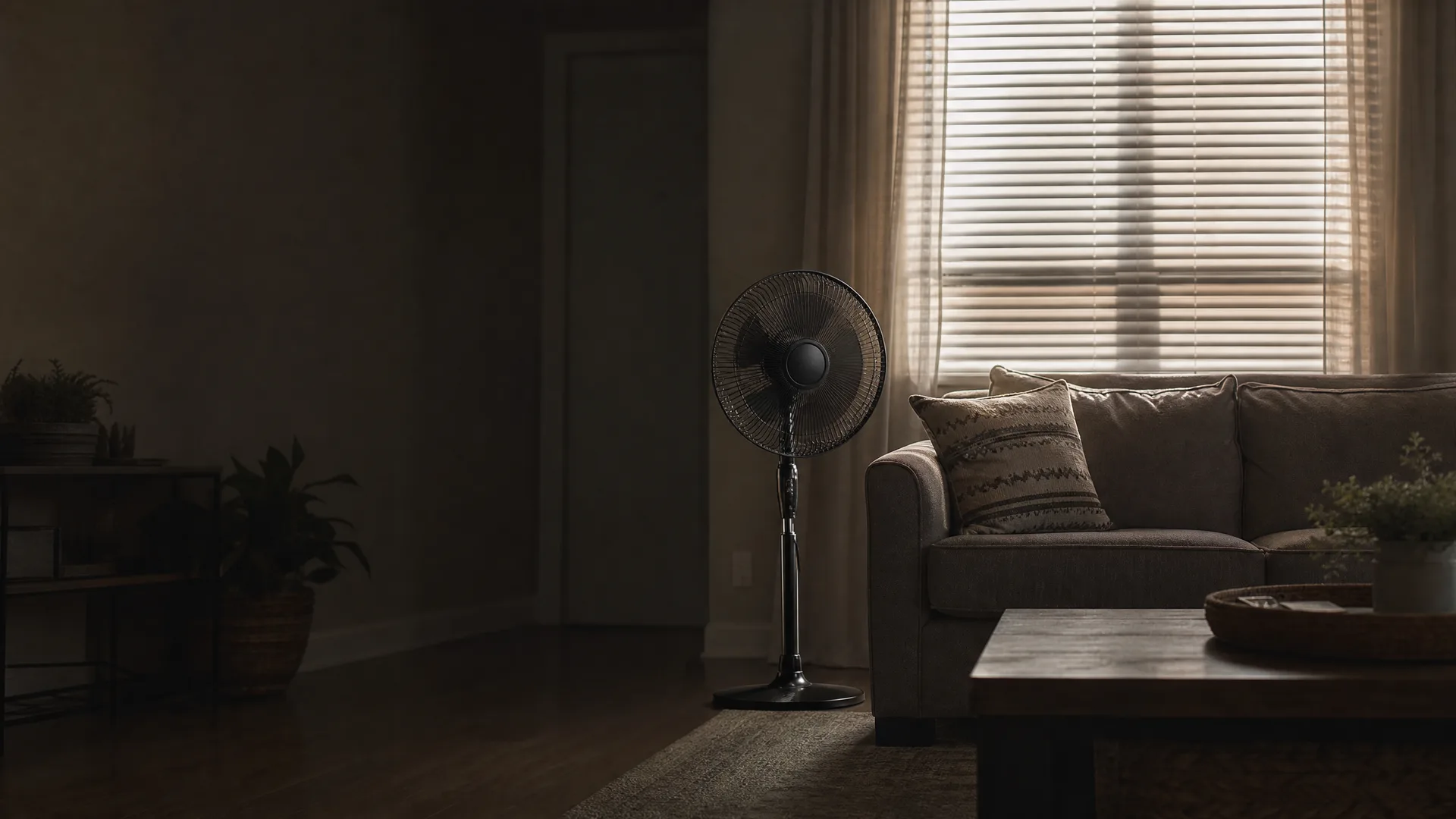
A dimly lit living room with a black pedestal fan on a wood floor beside a gray sofa with a patterned pillow, a wooden coffee table in the foreground, potted plants at left, and a curtained window with blinds behind.

By two in the afternoon the blinds are drawn against the sun, and the floor fan is running beside the couch doing what it can. It's not enough. The air in the living room sits heavy, the kind of July sticky that West Virginia gets into your clothes before you've been outside at all. You keep checking the thermostat like the number might change on its own. Someone's parked on the couch with a cold glass, trying to stay still because moving makes it worse. The fan just pushes the same warm air around the room. Outside, the condenser sits quiet when it should be running. You can hear how still it is.

Is it just stuffy, or is the air actually off

Check the vents first. If air is barely moving out of them, or it's coming out warm instead of cool, the system isn't doing its job anymore, even if you can still hear it running. Listen for a change too, a new rattle, a click that repeats without the compressor ever kicking on, or a hum that cuts off after a few seconds. Look at the thermostat screen. If it's blank or won't respond, that's worth knowing before you call anyone. A house that can't cool down holds onto heat room by room, and in a West Virginia summer that gets uncomfortable fast, especially for anyone in the house who doesn't do well in the heat.

A gray outdoor air conditioner condenser unit on a concrete pad beside a house with horizontal lap siding, with a wall-mounted disconnect box and conduit at left and a green shrub and mulch bed at right.

AC running fine

Cool air moves out of every vent, the thermostat holds the set temperature, and the unit outside cycles on and off like it should. No warm spots, no strange noise from the condenser by the siding. This is the baseline worth knowing so you notice fast when something changes.


An outdoor air conditioner condenser unit on a concrete pad beside a house with horizontal lap siding, with a conduit running to a gray electrical disconnect box on the wall.

AC in trouble

The condenser outside is running, but the air inside stays warm or barely moves. You might hear it straining, or notice it short cycling, shutting off and restarting within minutes. The disconnect box and wiring look fine from outside, which means the problem is inside the unit itself.

A woman with dark hair in a bun wearing a cream knit sweater sits on a gray sofa in a bright living room, looking off to the side.
A woman wrapped in a knit blanket sits on a gray sofa in a living room, looking toward a bright window with houseplants and an armchair in the background.
A woman in a gray cowl-neck sweater sits on a light sofa with cushions, smiling and looking to the side, with a kitchen and window visible behind her.
A woman with dark hair in a bun, wearing a light linen shirt, sits on a sofa and looks to the side, with a window, houseplants and a kitchen with pendant lights blurred behind her.

Why the outside unit matters

The condenser sitting outside carries the heat your house just gave up, and it has to move that heat into air that's already hot and loaded with moisture. On a muggy West Virginia afternoon that outdoor air is doing the system no favors. If the coil on that unit is caked with grass clippings, cottonwood fluff, or just months of dust, it can't shed heat the way it needs to, and the whole system works harder for less cooling. Walk out and look at it. A coil you can't see through, bent fins, or a unit crowded by shrubs are all things a contractor checks first, because they change how hard the compressor has to work before anything else gets diagnosed.

What the breaker tells you

Central air pulls a fair amount of current, enough that a tripped breaker is one of the first things worth ruling out. Go to the panel and look for one switched to the middle, not fully off. Reset it once. If it holds, the system may start back up on its own. If it trips again right away, something downstream is drawing too much power, and flipping it a second or third time won't fix that. That's a sign for a contractor to look at the compressor or the wiring feeding it, not something to keep resetting on your own.

An outdoor air conditioning condenser unit on a concrete pad beside a house with horizontal siding and a concrete foundation, with dry brown leaves on the ground to either side.
Before you get your air conditioner repair
A gray outdoor air conditioning condenser unit on a concrete pad beside a house with horizontal lap siding, with a wall-mounted disconnect box and conduit, and shrubs to the left.
After you get your air conditioner repair

A local pro for your air conditioner repair

A refrigerant leak, a bad capacitor, a condenser fan that's seized, these aren't the kind of thing you fix with a trip to the hardware store, and with the humidity West Virginia summers carry, a few days of guessing can turn into a week of sweating it out. You could call around and get three different quotes from three different companies, or you could hand it to one licensed contractor local to you, someone who's been inside West Virginia homes all summer and has a good idea what's wrong before they even ring your doorbell. They see this condenser fail in this heat every season. That's worth more than a stack of estimates when the house is already ninety degrees and climbing. Submit your information once, and it goes to a contractor who works on this equipment in this climate as a matter of routine, not a guess. The couch, the fan, the drawn blinds, none of that fixes the actual problem outside. Getting someone qualified looking at it does.

A gray outdoor air conditioner condenser unit on a concrete pad beside a house with horizontal siding and a light stucco wall, with a disconnect box and refrigerant lines on the wall and a shrub and mulch bed at left.

Riding it out without repair

Fans move the air around but they don't take the moisture out of it, so the room stays sticky even with one pointed right at you. Windows open at night help some, until the morning sun hits and the heat builds right back up. Ice packs and cold cloths get someone through an afternoon, not a week. Meanwhile the condenser outside may still be trying to run, drawing power without cooling anything, which does nothing for your bill and nothing for the person trying to nap in a hot bedroom.

A gray outdoor air conditioning condenser unit on a concrete pad surrounded by gravel, next to a white horizontal-lap-sided house wall with an electrical box and conduit, against a blank white background on the left.

Getting the system looked at

A contractor who works on these units all summer can tell you fast whether it's a capacitor, a fan motor, or a refrigerant leak, because they've seen the same failures on the same kind of equipment in other houses nearby. That's a different conversation than guessing with a fan running in the corner. Once the actual part is identified, the fix is usually straightforward from there. You stop losing days to the heat, and the people at home stop having to wait it out in a room that won't cool down.

A woman in a cream sweater and jeans stands in the open doorway of a white stucco house, holding the dark door, while a man in a dark quilted jacket seen from behind walks toward the entry past potted plants.

What happens between the thermostat and the cold air

The thermostat doesn't cool anything. It just sends a signal to the outdoor unit telling it to start, and a call for cooling has to make it through a string of parts before any cold air shows up. The thermostat tells the control board, the control board starts the condenser fan and compressor outside, and refrigerant starts moving between the outdoor unit and the coil inside near your furnace or air handler. A blower pushes air across that cold coil and out through your ducts. If any one link breaks, a dirty contactor, a capacitor too weak to start the compressor, refrigerant low from a leak, the rest of the chain either does nothing or runs without actually cooling the house.

That's why two systems that sound the same from the living room can be failing for completely different reasons, and why guessing at the part from the vent is hard to get right. A contractor who works on this equipment all summer in West Virginia has seen which of these tends to go first in a given brand or setup, and checking the chain in order is faster than replacing parts one at a time hoping something sticks. Getting matched with one contractor who already knows what to check first saves you the back and forth of explaining the system twice.

A gray upholstered sofa with a matching cushion sits beside a potted plant and a wooden table holding a small green plant in a stone pot, near a curtained window.
An outdoor air conditioner condenser unit on a concrete pad beside a house with beige horizontal siding and a stone-veneer base, with refrigerant lines running to a gray wall-mounted electrical box, surrounded by dark mulch, a flowering shrub and an evergreen on the left.

What normal looks like outside

The condenser sits on its pad by the siding, running steady, the fan inside turning without a wobble. The disconnect box stays shut and dry. No puddle underneath, no ice on the lines, nothing rattling against the stone veneer.

An outdoor air conditioning condenser unit on a concrete pad beside a house with light vinyl siding, an electrical disconnect box and conduit on the wall, bare shrubs and mulch to the right, and a concrete walkway in the foreground.

What trouble looks like outside

The unit by the disconnect box has gone quiet, or it's humming without the fan spinning. Maybe it's cycling off within a minute of starting. Either way, something inside that cabinet has stopped doing its job, and the house is already feeling it.

An older woman with gray hair in a bun and glasses, wearing a beige knit sweater, smiles while looking to the side in a warmly lit kitchen, with a loaf of bread on the counter in the foreground and a snowy scene outside the window.
A woman and a child wrapped together in a thick knitted blanket on a sofa, both with eyes closed, with a lit table lamp and houseplant in the dim background.
Single-story house with tan horizontal siding and a dark shingled hip roof, fronted by a patchy green and brown lawn and a concrete walkway leading to the covered entry.

Summer air here averages a 61°F dew point across June, July and August, per NOAA data, which is the sticky range where sweat quits evaporating off your skin. Your air conditioner isn't just dropping the temperature on days like that, it's pulling water out of the air, and that second job is what wears on it in West Virginia. When the system is working right you feel the difference immediately, the air goes from heavy to dry inside a few minutes. When it's not, or it's undersized or low on charge, the house might hit the set temperature but still feel damp and close, because the cooling happened without enough moisture coming out with it.

NASA POWER T2MDEW county cells weighted by homes

An outdoor air conditioning condenser unit on a concrete pad beside a house with white horizontal lap siding, with an electrical disconnect box and insulated refrigerant line on the wall and a shrub over mulch to the right.
A unit like this one is pulling its weight, cycling on and off without strain, keeping the house livable through a West Virginia summer.
An outdoor air conditioner condenser unit on a concrete pad beside a house with light horizontal lap siding, with an electrical disconnect box and conduit on the wall behind it.
Rust on the cabinet, a disconnect box that's seen weather, lines running bare along the foundation, this is a unit closer to its next breakdown than its last one.

Power costs 15.39 cents per kilowatt-hour statewide

At 15.39 cents a kilowatt-hour, running your AC through a West Virginia summer isn't cheap, but it's the going rate here, not a bad meter or a unit working harder than it should. If your bill jumps well past what that rate explains, something in the system is losing its fight against the heat.

EIA-861 2025 statewide residential average

When your AC quits in a West Virginia summer, the fix is almost never something to chase down yourself. A refrigerant leak needs gauges and a license to handle legally. A failed capacitor or a seized condenser fan needs hands that know what they're looking at. What you can do is narrow it down: check the vents, listen for the sound the system normally makes, look at the condenser outside for ice or a puddle. Past that, it's a job for someone who works on these systems every summer in this state and knows which part tends to go first in weather like this. Getting matched means one licensed local contractor reaching out to you, not a string of calls from companies that don't know your house. The humidity isn't going to let up on its own, and neither should the wait to get this looked at.

Sunlight falls across a beige upholstered sofa with a textured woven cushion and a chunky knit throw, beside a dark wood cabinet holding a ceramic vase with green leafy branches, near a white-framed window.
A sunlit corner of a room with a wooden side table holding a ceramic vase of green foliage and a wooden bowl, beside a light upholstered sofa with a knit throw and rust-colored pillow, with window shadows cast on a beige wall.
A sunlit room corner with beige walls, a white-framed window with sheer cream curtain, wood floor with a light rug, and a woven basket holding a knit blanket.
A beige ceramic vase holding a leafy green branch sits on a wooden cabinet in a corner, with sunlight through a sheer curtain casting leaf shadows on the wall.
A grey upholstered sofa with a rust-orange velvet cushion and a textured throw sits beside a window with linen curtains, next to a wooden side table holding a pale ceramic vase of olive branches.

Get the right pro for your air conditioner

The pro who reaches out is licensed in West Virginia.

Find a pro near me

No fee to send it, and nothing to sign.




















