

Musty smell from vents in Martinsburg, WV

Get matched with a pro who works on ducts in Berkeley County.

Get a duct system pro

Why do my vents smell musty in Martinsburg, WV?

You turn on the AC or the heat and that musty, basement-like smell comes through the vents. It's not strong enough to be an emergency, but it's there every time the system runs, and it makes you wonder what's sitting in your ductwork. You keep the house clean, so a smell like this stands out, and you want to know what's actually causing it before you decide what to do about it.

It's moisture sitting in your ducts, usually growing mold or mildew on dust buildup

That smell is almost always moisture that got into the ductwork and never fully dried out, feeding mold or mildew on the dust and debris that collects inside the system over time. Berkeley County summers run muggy, and a central AC system pulls humidity out of the air and condenses it near the coil and the ducts closest to it. If dust has built up in there, it gives mold something to grow on, and every time air moves through, it carries that smell into the room. The longer it sits, the more it spreads through the duct system, so the smell tends to show up in more rooms over time rather than fewer.

Unfinished basement corridor with exposed wood floor joists, pipes and wiring overhead, sheet-metal HVAC ductwork and an electrical panel along the left wall, and a blank white wall on the right.

Where the smell is coming from

That smell usually sits in the evaporator coil, the cold coil inside the air handler that the air passes over every time the system runs. Summer humidity condenses on that coil, and the moisture that doesn't drain off sits on the coil fins along with whatever dust has settled there. Run the system for months in a row through a muggy season and that combination grows mold. The air moving past it picks up the smell and carries it straight out your vents.

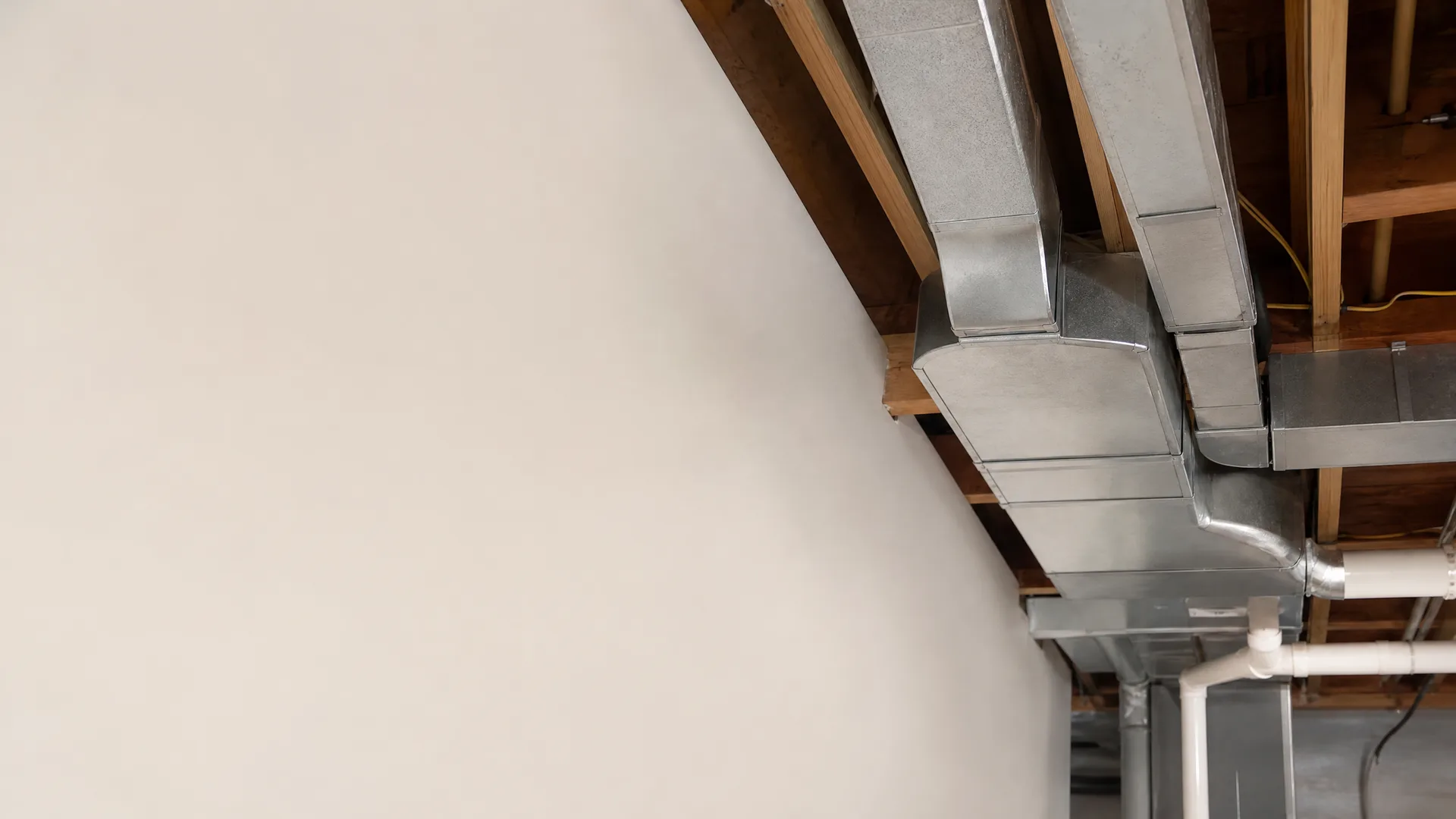
Interior basement ceiling with exposed wooden joists, sheet-metal HVAC ducts, and white PVC pipes beside a plain off-white wall.

Why cleaning alone may not fix it

A duct cleaning clears dust and debris out of the supply and return runs, and that helps if the smell is coming from buildup inside the ductwork itself. But if the mold is growing on the evaporator coil or sitting in the drain pan under it, air moving through clean ducts will still pick up that smell on its way past the coil. A thorough job checks both the ducts and the coil, not just one or the other.

Why does this smell show up in so many Martinsburg houses?

  • Half the homes here were built by 1996

    Half the homes in Berkeley County were built in 1996 or earlier, per Census data. Ductwork that old has had a long time to collect dust the coil can feed mold.

  • Heat runs October through April

    Heat runs October through April here. That's seven months where a damp coil and dusty ducts sit mostly idle, giving mold time to settle in.

  • Cooling runs June through August

    Cooling runs June through August here. Those are the months the coil stays wet longest, and the smell you notice usually traces back to that stretch.

ACS 2020-2024 · NOAA nClimDiv 1991-2020

Running the AC yourself to dry it out

Some homeowners run the AC for a while with the fan on, hoping to dry out the coil and chase the smell off. It can knock the edge off for a day or two, especially if the duct system just needs more airflow through it. But if mold has already taken hold on the coil or in the ductwork, moving air across it doesn't remove it. The smell comes back as soon as humidity builds up again, and running the system longer than it needs to run adds to the power bill without solving what's sitting on that coil.


Having the coil and ducts cleaned

A contractor can get into the air handler and the duct runs themselves and clean off what's actually growing there, not just move air past it. That means someone inspecting the coil, the drain pan and the duct interior, then cleaning what they find instead of guessing. It takes more coordination than turning a dial, finding someone who services Berkeley County homes, explaining what's going on, getting a quote you can compare against another. Matching with a contractor through this page skips that part and gets you to someone who can look at it directly.

A gray-haired bearded man in a dark snow-dusted coat and scarf stands inside a dimly lit home entryway, with a hallway, framed picture, lit table lamp and staircase behind him.
An older man with gray hair and a beard, wearing a dark snow-dusted coat, stands in a warmly lit home entryway with a hallway, console table with lamp, patterned rug, and living room visible behind him.
An older man with gray hair and a beard, wearing a dark coat dusted with snow and a blue plaid scarf, stands smiling in a dimly lit entryway with a window, framed picture, table lamp and staircase behind him.
A gray-haired man in a dark coat dusted with snow stands in a warmly lit home entryway, with a lamp, sofa, window and white staircase banister behind him.

What a real cleaning covers

  • The evaporator coil sits in a sealed cabinet, so a cleaning has to reach inside it, not just the ductwork.
  • Coil cleaner breaks down the mold film on the fins, and the condensate line flushes it out instead of letting it sit in the drain pan.
  • A technician checks the condensate drain itself, since a clogged drain line lets water back up and keep the coil wet between cleanings.
  • Supply and return ducts get cleaned separately from the coil, since dust sitting in the ducts feeds the mold even after the coil is clear.
  • The blower wheel and housing collect the same film as the coil and get wiped down while the cabinet is already open.
  • A UV light installed near the coil keeps mold from regrowing on it between cleanings, though it doesn't replace the first cleaning.

A musty smell fix isn't a once-over with a shop vac on the ductwork. The coil sits inside a closed cabinet in the air handler, so getting to it means opening that cabinet up, not just running a brush through the supply lines. Once it's open, a coil cleaner goes on to break down the mold film sitting on the fins, and the condensate line gets flushed so that film washes out of the system instead of settling back into the drain pan. That drain line is worth checking on its own. If it's clogged, water backs up under the coil and keeps it wet, and a wet coil grows mold back fast no matter how clean it was the day before. The ducts get handled separately from the coil, since dust sitting in the supply and return runs will feed new mold growth even after the coil itself is spotless. While the cabinet is open, the blower wheel and housing usually get wiped down too. They sit right next to the coil and pick up the same film, and it's easy work to do while everything's already apart. Some setups add a UV light mounted near the coil afterward. It keeps mold from building back up on the coil between cleanings, but it's not a substitute for the cleaning itself. It only works on a coil that starts out clean.

Unfinished basement with bare concrete floor and walls, exposed wood joists, metal ductwork, a furnace unit, steel support posts, and a small window.
Clean ducts and a dry coil mean the air moving through this basement and up into your rooms has nothing to pick up on the way.
Empty basement with bare concrete walls and floor beneath an exposed wood-joist ceiling carrying galvanized sheet-metal ductwork, round ducts and pipes.
Dust built up on duct interiors and standing water in the drain pan give mold a place to grow and the air a way to carry it.
A woman wrapped in a thick textured blanket sits on a sofa with an open book on her lap, beside a lit lamp and bookshelf, with a frost-patterned window behind her.
An older woman with grey-blonde hair in an updo and a beige turtleneck sweater smiles while looking to the side in a warmly lit kitchen, with a round loaf of bread on the counter in front of her and a dark window showing snow outside.

A duct system pro near you

Explain the job once and skip repeating it on every call.

Sending the form costs nothing.

Unfinished basement with bare concrete walls and floor, exposed wood joists, and galvanized sheet-metal HVAC ductwork and pipes running across the ceiling.

Duct system running clean

Air moves through the sheet-metal ducts and past the copper tubing and PVC without picking anything up. The coil stays dry between cycles and the metal surfaces inside stay bare, so nothing is sitting in the duct run for air to carry up into your rooms.

Basement ceiling with galvanized sheet-metal ductwork, wooden joists and subfloor, black and white pipes, above a concrete wall and floor.

Duct system in trouble

At the junction where ducts branch off, dust has built up along the inside of the metal and the drain line nearby isn't moving water the way it should. That's what feeds the smell, and it sits right next to the ductwork carrying air to the rest of the house.

What does this smell mean for your house

You notice it most when the system first kicks on, a damp, closed-in smell that fades after a few minutes but keeps coming back. Sometimes it's stronger in one room than others, depending on which vent is closest to the air handler. You might see a faint ring of dust or dark specks around the vent covers themselves. Left alone, the mold feeding that smell can spread across the coil fins and into the drain pan, and what started as an odor becomes mold spores riding the air into every room the system serves. Anyone in the house with allergies or asthma is going to feel that before anyone else does.

  1. A technician pulls the access panel and inspects the coil and drain pan first

  2. A cleaner is applied to the coil fins to break down the mold film

  3. The condensate line gets flushed so the loosened film drains out

  4. Supply and return ducts get cleaned so nothing left behind feeds new growth

Empty basement room with bare concrete walls and floor, exposed wooden floor joists overhead, large galvanized sheet-metal ducts with a vent grille, colored pipes, and a single lit bulb.
Before you get your ductwork cleaning
Empty unfinished basement with bare concrete floor, insulated walls with vapor barrier between wood studs, exposed wood joists, galvanized sheet-metal ductwork, a recessed light, and a steel support column.
After you get your ductwork cleaning

Keep waiting and the smell settles into the house. Mold on the coil spreads over a season of summers, and it stops being something you smell only when the system kicks on.

Get it cleaned and the coil runs dry again, with nothing on the fins or in the drain pan for the air to pick up. The smell goes with it, not just the edge taken off it.

Power here costs 13.10 cents per kilowatt-hour

At 13.10 cents per kilowatt-hour, running the blower longer than you need to isn't what's driving your bill. A fan-only cycle to dry out the coil costs you almost nothing. Letting mold sit and spread so the system has to fight to push air through is what adds up.

EIA-861 2025

The musty smell coming through your vents is mold on the evaporator coil, or standing water in the drain pan, or dust built up in the ducts after years of running. It's not dangerous, but it doesn't clear up on its own, and running the fan or swapping the filter only masks it for a day or two. A cleaning reaches the coil, flushes the condensate line, and clears the ducts so the air moving through your house has nothing left to pick up. Instead of spending your afternoon looking up duct cleaning companies in Berkeley County, calling a few, explaining the smell and when it shows up, then trying to compare quotes that are never quite for the same job, you can get matched with a contractor who handles this and have them reach out to you. The smell has an explanation and a fix. Where you stand now is simple: you know what's causing it, and you know what it takes to clear it out.

A lit flagstone walkway bordered by low path lights and shrubs leads to the covered front entry of a light-colored clapboard house with a dark door, flanking potted plants, and a glowing porch light at dusk.

Ductwork Cleaning

Get matched with a duct system pro in Berkeley County

Duct and vent cleaningDucts or ventsBerkeley County, WV
Step 1 of 2

What ZIP code is the job in?

  • A ceramic vase holding dried flowers and a shallow stoneware bowl sit on a wooden table beside a bright window, with a paneled wall and framed picture behind.
    • Get matched with a Berkeley County pro who cleans ducts.
    • A local pro who cleans ducts gets in touch with you.
  • A stoneware jug holding dried pink and green hydrangea blooms sits on a polished wooden sill beside a dark lidded box and a metal candlestick, in front of a multi-pane wood window with blurred greenery outside.
    • After you send the request, you're done searching.
    • Send the form and the duct cleaning stops sitting on your list.
  • A white window sill holding a ceramic vase with olive branches and a shallow wooden bowl, with blurred green foliage and a neighboring roof visible through the window and a woven basket below.
    • One form replaces the calls you'd make to find a duct system pro.
    • Skip calling around for someone who cleans ducts.
  • A green fern in a light gray ceramic pot with a matching saucer sits on a wooden table beside a glass-based lamp, next to a curtained window.
    • Your request stays with one local pro.
    • Your duct cleaning request goes to one local pro.