














Signs of mold in your air ducts in West Virginia

A galvanized steel round duct with a 90-degree elbow and a circular louvered vent grille at one end, photographed against a plain light gray background.
Find my pro

A musty smell when the air handler kicks on is usually the first sign, along with dark spots around the vent covers or a stuffy feeling in rooms that never used to have one. West Virginia summers get humid, and when warm, damp air meets the cool metal inside your ducts, moisture collects there. Mold needs that moisture to grow, so it spreads along the duct walls where the air stays wet longest. Some homeowners also notice allergy symptoms that ease up when they leave the house and come back once they're inside again. Visible mold at a vent opening means it's established further back in the duct, not just at that one spot. None of this clears up on its own, since the ducts stay damp every time the system runs and humidity builds back up. Catching it at the musty smell stage, before it spreads through the whole system, is a lot easier to deal with than waiting until it shows at every vent in the house.

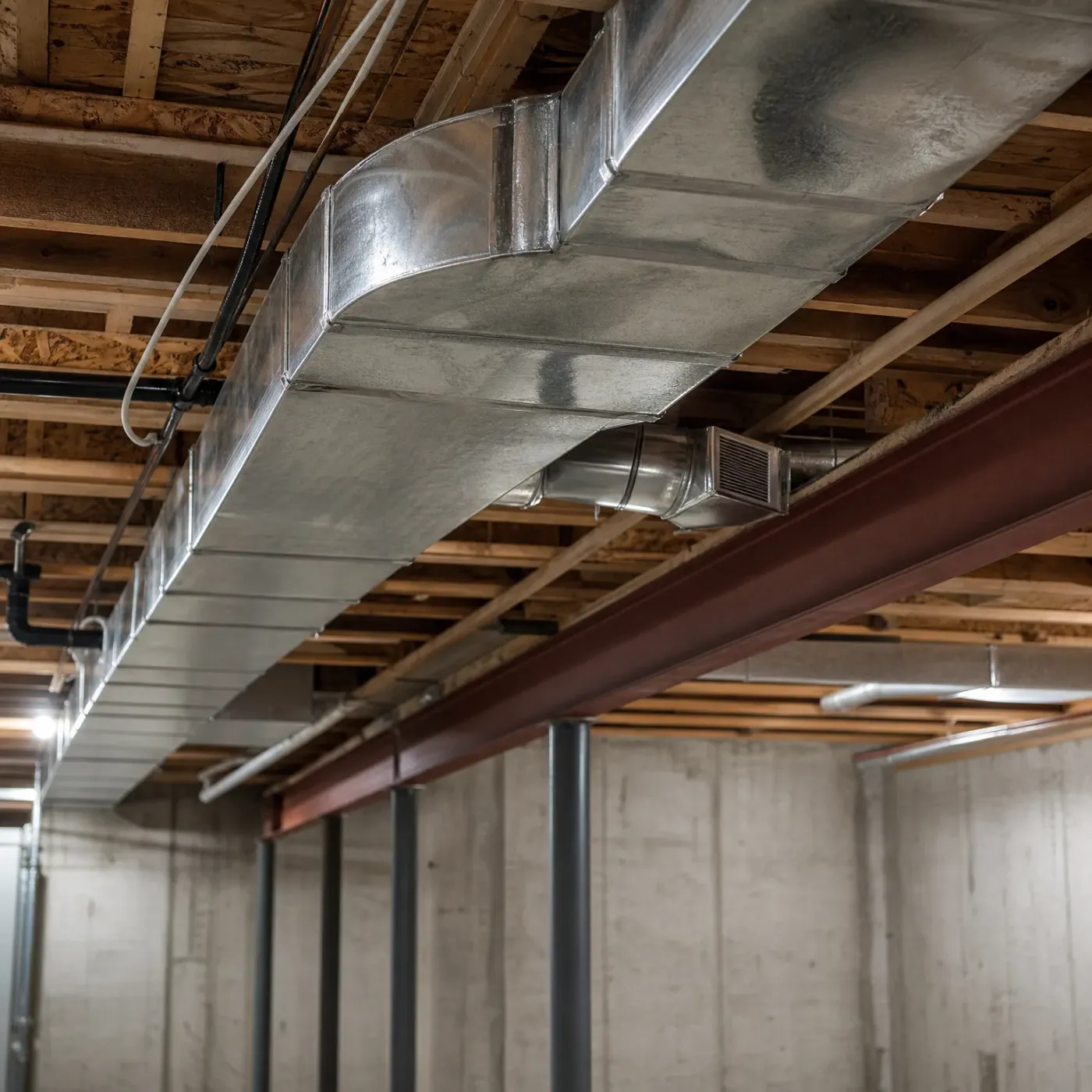
Empty unfinished basement with concrete walls and floor, exposed wood joists, metal HVAC ducts and pipes overhead, and a steel support column near a framed wall.
Clean metal ducts with no staining or odor, air moving freely through every run to the rooms it feeds.
Empty basement with bare concrete walls and floor, a steel support column, and galvanized sheet-metal ductwork and pipes running along the exposed wood joist ceiling.
Dark staining spreading across the metal near a joint, a sign of moisture sitting where it shouldn't.
A woman in a cream cowl-neck sweater sits by a window with snow outside, in a dimly lit living room with a sofa, lit lamp, mirror, candles and a fireplace.
A woman in a gray turtleneck sweater sits beside a large window looking out at snow-covered evergreen trees, in a dimly lit living room with a lit fireplace, lamps, couch and houseplant.
A woman in a cream turtleneck sweater stands beside a large window with snow-covered ground and bare trees outside, in a dimly lit living room with lamps, a sofa and framed art.
A woman in a grey cowl-neck sweater stands indoors near a window, looking out at falling snow, with a lamp, framed picture and couch in the warmly lit room behind her.

Clean Now or Wait It Out

Clean the ducts now

  • A contractor can reach the staining before it spreads to runs that are still clean.
  • Loose debris and growth get pulled out of the system instead of recirculating every time the air handler runs.
  • You find out what's behind the smell, whether it's isolated to one joint or spread through several runs.
  • Humid West Virginia summers mean the problem can return, so catching it early keeps the job smaller.
  • A local contractor who works on duct systems through the summer knows where moisture tends to collect in homes here.

Wait and watch

  • The musty smell and stuffy rooms keep going until someone looks at the ducts directly.
  • Staining on the metal tends to spread rather than stay put, especially through a humid summer.
  • Rooms fed by the affected run keep getting air that passed over the damp, stained metal.
  • Nothing gets confirmed, so you're left guessing whether it's one spot or a bigger problem.
  • The longer it sits, the more metal and runs may end up needing attention.
Unfinished basement interior with exposed wooden floor joists, galvanized rectangular and round sheet-metal ducts, a gray furnace unit at left, and a large blank light-colored wall at right.

Where moisture collects in ductwork

Return runs carry air back toward the air handler, and that air is often the most humid in the house, pulled from bathrooms and rooms with little airflow. If a duct seam isn't sealed tight, humid summer air can work its way in and settle on the metal. Low spots in the duct run, especially near the air handler, hold that moisture longest. That's usually where staining and growth start, not out near the vent covers themselves.

Galvanized sheet metal ductwork with elbows and a vent grille running beneath an exposed wood joist and OSB ceiling, next to a blank white wall.

Why the air handler matters

The air handler cycles on and off all summer, and each time it starts, it pulls air across whatever has collected on the coil, the drain pan, and the first few feet of duct. If mold is growing near the handler, that first rush of air is what carries the smell into the house. A contractor checking for duct mold usually starts right there, since it tells them whether the problem is isolated or has spread further into the runs.

Power costs 15.39 cents per kilowatt-hour statewide

Most homes in West Virginia heat with electricity, and at 15.39 cents per kilowatt-hour, that's what you're paying to push air through ducts that mold has narrowed or fouled. A system working harder to move the same air costs more every month it runs that way.

EIA-861 2025 statewide residential average

  1. Humid return air settles on cool metal duct surfaces overnight.

  2. Condensation collects at seams and joints where metal meets metal.

  3. Mold spores already in the ductwork find standing moisture to feed on.

  4. A colony spreads across the damp patch within days.

A bearded man in a plaid flannel shirt stands in a kitchen looking out a window toward snow-covered shrubs, with a steaming mug on the windowsill and potted plants on a shelf behind him.
A smiling man with dark curly hair in a navy t-shirt sits on a gray couch indoors, with a large-leafed plant and a window in the background.
Galvanized sheet metal trunk ductwork with a round branch and register running beneath wood floor joists in an unfinished basement, alongside pipes, wiring, a steel beam and concrete walls.

A local pro for your ductwork cleaning

Your duct cleaning request goes to one local pro.

Your duct cleaning request goes to a local pro who does this work.

Find a licensed pro

No charge to send it. You decide if you hire them.

What would you actually notice in your own house?

You'd likely catch it before you see it. A smell that's there when the air kicks on and fades after a few minutes. A room down the hall that stays sticky even with the thermostat set right. Maybe dust that settles faster than it used to on the shelf under a vent. Some households notice it first in a sneeze that happens every time they walk into one particular room. None of this is dramatic on its own, which is why it gets explained away as a bad summer or an old house. Left alone, what's growing in the ducts keeps getting pushed into the air everyone in the house is breathing, every time the system runs.

Galvanized sheet-metal ductwork and round pipes run along a wooden floor joist ceiling above a bare concrete wall and floor.
Before you get your ductwork cleaning
Unfinished basement with concrete floor and walls, exposed wood joists, steel support posts, and large galvanized sheet-metal ductwork running to a furnace or air handler against the far wall.
After you get your ductwork cleaning
Unfinished basement with bare concrete floor and walls, exposed wood joists, metal ductwork, a furnace unit, steel support posts, and a small window.

Ducts doing their job

Sheet-metal runs cross the ceiling clean and dry, carrying air to every room without a smell riding along with it. The furnace and water heater sit below, doing their work, while the ductwork above them just moves air the way it's supposed to.


Empty basement with bare concrete walls and floor beneath an exposed wood-joist ceiling carrying galvanized sheet-metal ductwork, round ducts and pipes.

Ducts in trouble

The same kind of run, but moisture has gotten into the joints where the spiral duct meets the trunk line. Growth takes hold in the dark and spreads along the metal before you ever see it, feeding on whatever humidity the return air carries in.

A woman stands in the open doorway of a white stucco house holding the dark door, facing a man in a black cap and shirt seen from behind in the blurred foreground, with a potted flowering plant beside the entry.

Catching it now is the whole point

The signs are the smell, the staining near the vents, the room that stays sticky no matter where you set the thermostat. If you've noticed one of those, your ducts are telling you something before the problem gets bigger. That's worth acting on while it's still a cleaning job and not something more involved.

A contractor local to West Virginia who cleans ducts through summers like this one has seen this exact pattern before, in homes not unlike yours. Getting matched with one contractor means someone who can look at what you're describing and tell you plainly whether it matches what you're smelling and seeing, instead of your inbox filling up with quotes from companies that have never been inside your house.

Interior corner of a living room with a beige upholstered sofa and dark cushion in the foreground, a ceramic vase of leafy branches on a dark side table by a curtained window, a framed picture on the wall, and a wood-surround fireplace at right.
Dimly lit interior showing galvanized sheet-metal HVAC ductwork running below a wooden joist ceiling above a dark gray wall.

Get the right pro for your ductwork

Only one pro gets your request, so you hear from one company.

Duct and vent cleaningDucts or ventsWest Virginia
Step 1 of 2

What ZIP code is the job in?

